Published on
April 23, 2026 • by

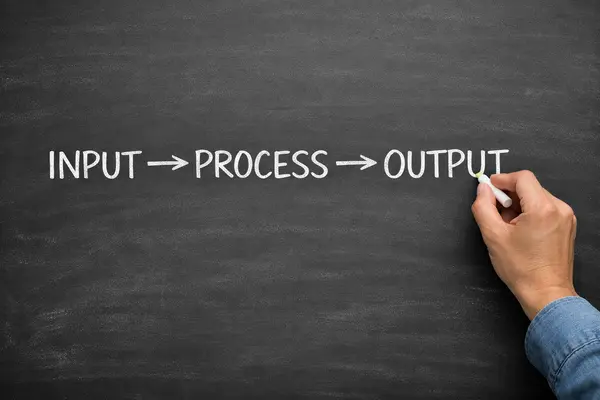
Input → Process → Output
Episode 13: Computational Thinking - the framework for life. In this episode, I break down how the simple loop of input → process → output quietly shapes your behaviour, your clarity, and the quality of your life. Once you see it, you can’t unsee it — and you’ll start noticing how every system around you reflects exactly what you feed into it.
Listen to the full episode
Transcript
🎙️ INTRO
Welcome to cherryontop.cafe. My name’s Yvette and I'm your guide, your host, and your barista.
Today we’re talking about something that sounds very technical, very “coder‑ish”. It’s called Computational Thinking. But no, don't get freaked out — you won’t need to learn how to code HTML or JavaScript. You won’t even need to know what an algorithm is or how it works. I know I don’t, and I’m the techie in the room.
What you will learn today is how three simple words can genuinely change your life. Curious? Grab a coffee, settle in, and let’s begin.
INTRO MUSIC
Today we’re diving into something that sounds like it belongs in a computer science lecture, but actually lives in your kitchen, your relationships, your routines, and frankly, your life.
It’s called Computational Thinking — and it’s the one framework that quietly explains why your life feels chaotic… or not.
I first came across Computational Thinking in early 2024 maybe… during the time when I took interest in coding and joined a Web Development bootcamp. At that time, I was convinced that I was about to become one of the cool guys behind the laptop.
Then I opened the pre‑course materials… and there it was, the model explained using dirty dishes. But honestly? I loved it. It was simple. It made sense.
I thought: “Wait… this is not just coding. This is… life.”
So, what is Computational Thinking? Well, imagine you’ve got a problem — a big one. Instead of panicking, you break it down using Computational Thinking. Which really just means that you process it through four simple steps: Decomposition, Pattern Recognition, Abstraction, and Algorithmic Thinking.
Here’s how it works:
First, Decomposition — you take your big problem and split it into smaller, manageable pieces you can actually deal with.
Then comes Pattern Recognition — you look at those pieces and notice what keeps repeating.
Next is Abstraction — you strip away the noise, the useless bits, the distractions, so you can focus on what actually matters.
And finally, the last stage is Algorithmic Thinking, when you create a clear, step‑by‑step plan to get from point A to point B, from where you are to where you want to be.
Simple, right?
It’s less about computers and more about clarity, structure, and clean thinking. It's the mindset.
The mechanism you can use are the three words that I mentioned in the intro:
Input → Process → Output
Or, as programmers say: Garbage In, Garbage Out.
In coding, this shows up everywhere.
First example:
Imagine you build a button on a website. The input is someone hovering over it. The process is the code reacting to that hover. And the output is the button doing what it's supposed to do — maybe giving a little wiggle.
Let’s take another example — something from daily life. Since we've already mentioned garbage in, garbage out…
Let's assume your trash is full. Let's also assume you have a partner. Or a family. Or children. So, you do the reasonable thing: you input the information into your partner. Or children. Or family.
Something polite like, “Hey, the bin is full,” which, in your head, should trigger a very simple process: they hear the words, they understand the words, they stand up, and take the bin out.
A four‑step algorithm. Nothing complex.
And so the output you're expecting is the trash leaving the premises.
Of course, depending on the partner, the family, or the children, the output might also be: “In a minute!”
I don't live with you, so I can't tell.
What I'm trying to say, though, is that when you think about it, everything in your life runs on an input–process–output loop. Whatever you take in — your food, your hydration, the information you consume, the people you interact with, the environments you place yourself in, even the way you speak to yourself — all of that becomes the raw material your system has to work with.
Then comes the processing stage: your emotional regulation, your identity, your boundaries, your logic, your nervous system. That’s where everything gets filtered, interpreted, and transformed.
And finally, you get the output: your behaviour, your tone, your decisions, your presence, your results. This is where the GIGO principle comes in — Garbage In, Garbage Out.
If your inputs are chaotic, noisy, junk‑food‑level, full of emotional vampires, overstimulation, guilt, or unclear expectations, your outputs will reflect that. But when your inputs are clean — quiet environments, hydration, protein, emotionally regulated people, clear boundaries, high‑quality information — your outputs become clean too.
Your body is the most literal example. Doctors can tell what your inputs have been just by looking at your outputs. Your digestion, your energy, your weight, your bloodwork — all of it is basically a report card on what you’ve been putting in. If you treat your body like a bin, it will behave like one.
And I'm saying that as someone who has been suffering the consequences of an unhealthy lifestyle for a while now. But that's for another story.
So, Computational Thinking. Input — process — output.
It’s simple, it’s logical, and once you see it, you'll start looking for it everywhere.
Computational Thinking isn’t really about coding. It’s about clarity. It’s about recognising that your life is a system — and systems always reflect the quality of their inputs.
If you want a clean life, you need clean inputs. If you want aligned behaviour, you need aligned processing. If you want a grounded identity, you need grounded information.
This isn’t a personality change. It’s a systems upgrade.
It’s simple, elegant, universal — and once you see it, you can’t unsee it.
So as you listen to this, remember: Protect your inputs. Your outputs depend on them.